 how-to
How to Store Lyophilized Peptides: A 2026 Guide
Last Updated: October 23, 2026
Quick Summary
Store lyophilized peptides in sealed, airtight containers at −20°C or colder for long-term preservation lasting 1-3 years, or at 4°C for short-term use of several weeks to months. Keep them protected from light, moisture, and heat, and minimize freeze-thaw cycles to maintain stability.
- Store at −20°C or −80°C for long-term stability; −80°C extends shelf life further than −20°C
- Use amber or dark glass vials with tight-sealing caps and desiccant packets to prevent moisture and light damage
- Aliquot peptides into smaller portions before freezing to minimize freeze-thaw cycles and condensation events
- Reconstituted peptides degrade faster and should be used within 1-4 weeks when stored at 4°C
- Allow 10-15 minutes equilibration time before opening thawed vials to prevent condensation inside the container
Table of Contents
- Why Proper Storage Matters for Lyophilized Peptides
- Choosing the Right Lyophilized Peptide Storage Temperature
- Protection from Light, Moisture, and Heat
- How Long Do Lyophilized Peptides Last in Storage
- Peptide Freeze-Thaw Stability and Best Practices
- Peptide Storage After Reconstitution
- Storage Logs and Documentation
- What to Do After a Temperature Excursion
- Frequently Asked Questions
Why Proper Storage Matters for Lyophilized Peptides
Lyophilized peptides are fragile. They're freeze-dried powders designed for long-term stability, but only under the right conditions.
The stakes are real for researchers. A batch that arrives perfect can become unusable within weeks if stored improperly. Oxidation, hydrolysis, and moisture absorption happen silently.
This guide from Amoravia covers how to store lyophilized peptides correctly.
Why does it matter? Because your storage decisions directly affect:
- Shelf life stability: Months versus years
- Chemical integrity: Preserved amino acid sequences
- Experimental reproducibility: Batch-to-batch consistency
- Research timeline: No surprises mid-project
The good news: storage is straightforward once you know the fundamentals. Temperature, moisture, light, and air exposure are the four factors that control everything.
Choosing the Right Lyophilized Peptide Storage Temperature
The storage temperature you choose determines how long your peptides remain stable. Different conditions suit different situations. Your choice depends on how long you need to keep the peptide and how often you'll access it.
Freezer Storage: −20°C and Below
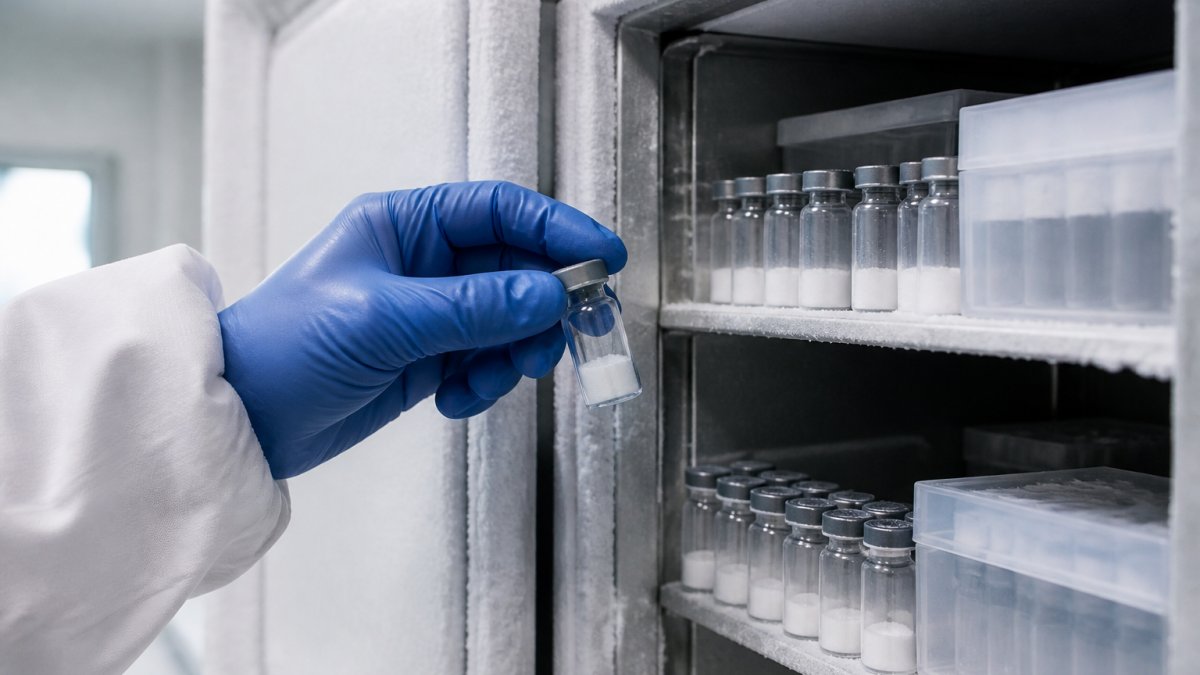
Freezer storage at −20°C or colder is the standard for long-term preservation.
At −20°C, lyophilized peptides remain stable for extended periods. Many peptides stay viable for several years under these conditions. The cold slows chemical degradation to near-zero.
−80°C freezers offer even longer stability (ncbi.nlm.nih.gov). If you have access to an ultra-low freezer, use it for your most critical compounds or longest-term storage.
When to use freezer storage:
- Long-term storage beyond 6 months
- Compounds you'll use infrequently
- Research-grade peptides where consistency is critical
- Any peptide where you need maximum shelf life
One practical note: freezer storage requires a reliable power supply and temperature monitoring. A freezer failure can damage your entire stock.
Refrigerator Storage: 4°C and Short-Term Use
Refrigerator storage at 4°C works for short-term use. This is your option when you plan to use the peptide within weeks or a few months.
Lyophilized peptides at 4°C remain stable for shorter periods than frozen samples. Most peptides stay usable for several weeks at this temperature.
The advantage of refrigeration is convenience. You don't need a freezer. Access is faster. Temperature fluctuations are smaller than in a freezer-thaw cycle.
When to use refrigerator storage:
- Peptides you'll use within 1-3 months
- Compounds in active experiments
- Situations where frequent access is necessary
- When freezer space is limited
The trade-off is shorter stability. If your project extends beyond a few months, move the vial to a freezer.
Room Temperature: Limited Viability
Room temperature storage is not recommended for long-term use. However, lyophilized peptides can remain stable at room temperature for limited periods under specific conditions.
Lyophilized peptides protected from heat, light, and moisture can remain stable at room temperature for weeks. The key word is "protected." This means sealed vials in a cool, dark location, not on a bench in sunlight.
Room temperature storage works for:
- Peptides in sealed, unopened vials
- Storage duration of days to a few weeks
- Temporary situations during shipping or handling
- Compounds you're actively using in the lab
Beyond a few weeks at room temperature, degradation accelerates. Don't rely on room temperature for anything you need to preserve.
Protection from Light, Moisture, and Heat
Three enemies degrade lyophilized peptides: light, moisture, and heat. Control these three and you control stability.
Sealing and Desiccant Use
A sealed vial is your first line of defense. Once a lyophilized peptide is sealed, it's protected from air and moisture. Keep it sealed until you're ready to use it.
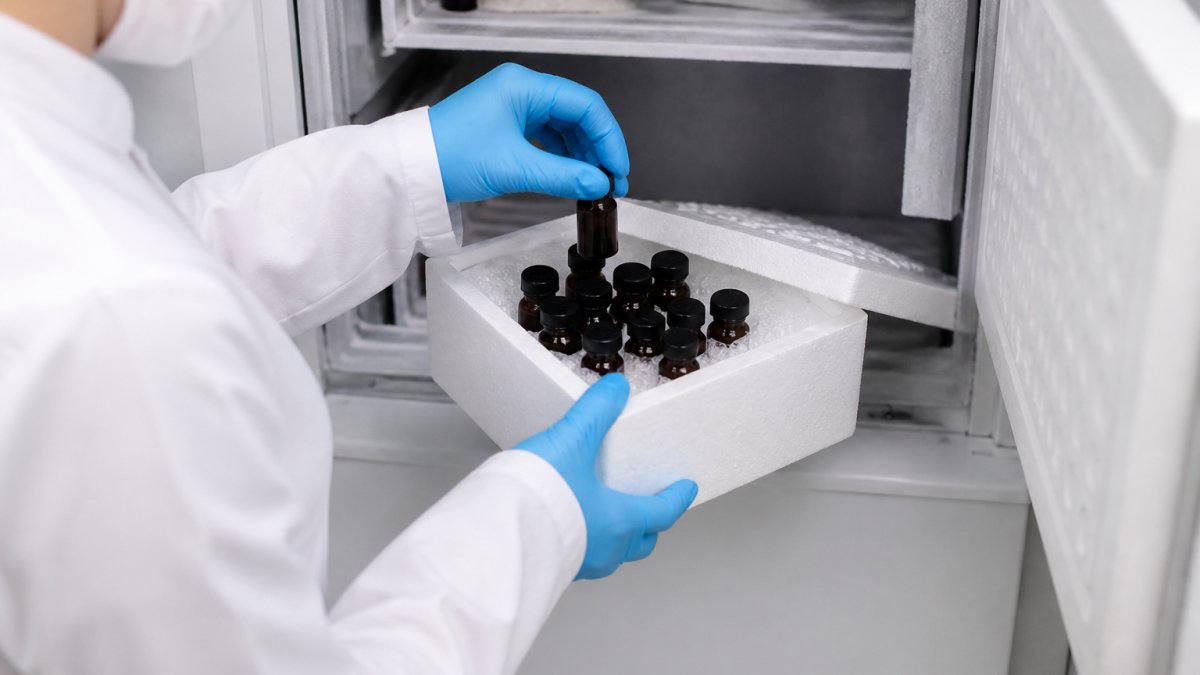
Use airtight containers. Glass vials with screw caps or crimp seals work well. Amber or opaque glass is better than clear glass because it blocks light.
Desiccants matter. Silica gel packets or molecular sieves inside storage containers absorb moisture from the air. This keeps the environment dry around your peptides. Replace desiccants periodically if you're storing peptides for years.
Storage container best practices:
- Use amber or dark glass vials
- Ensure caps seal tightly
- Store vials in airtight containers with desiccant
- Check desiccant color regularly (color-changing desiccants show when they're saturated)
- Keep backup desiccants on hand
Managing Temperature Fluctuations and Condensation
Temperature swings damage peptides. Every time you move a frozen vial from a −20°C freezer to room temperature and back, you risk condensation inside the vial.
Condensation is the silent killer. When a cold vial warms, moisture condenses on the powder surface. This liquid water accelerates hydrolysis and oxidation. One condensation event can shorten shelf life significantly.
Prevent condensation by:
- Minimize temperature transitions: Only remove vials from the freezer when you need them
- Allow equilibration time: Let a vial sit at room temperature for 10-15 minutes before opening (don't open it during this time, just let the outside warm)
- Use sealed storage boxes: Store multiple vials together in an insulated box; they warm together, reducing individual condensation
- Avoid repeated freeze-thaw cycles: Each cycle stresses the peptide and increases degradation risk
- Store in a stable freezer: Avoid freezers with automatic defrost cycles that cause temperature fluctuations
If you must access peptides frequently, consider keeping a small working stock at 4°C and a larger reserve at −20°C or −80°C.
How Long Do Lyophilized Peptides Last in Storage
Shelf life depends on storage conditions. Under ideal conditions, sealed, frozen, protected from light and moisture, lyophilized peptides remain stable for several years.
The exact timeframe varies by peptide. Different amino acid sequences have different stability profiles. Some peptides are more resistant to oxidation. Others are more prone to hydrolysis.
Typical shelf life estimates:
| Storage Condition | Expected Stability | Best For |
|---|---|---|
| −80°C, sealed, dark | Several years | Maximum preservation |
| −20°C, sealed, dark | 1-3 years | Standard long-term storage |
| 4°C, sealed, dark | Several weeks to months | Short-term use |
| Room temperature, sealed, dark | Weeks only | Temporary storage |
These are estimates. Amoravia includes detailed Certificates of Analysis with every shipment, documenting identity and purity at the time of delivery.
Keep storage logs. Note the date you received the peptide, the storage temperature, and when you used it.
Peptide Freeze-Thaw Stability and Best Practices
Freeze-thaw cycles stress peptides. Each cycle introduces risk: condensation, oxidation, mechanical stress from ice crystal formation.
Minimize freeze-thaw events. This is the single most important practice for long-term storage.
How to minimize freeze-thaw stress:
- Aliquot before freezing: Divide your peptide stock into smaller portions before first use. Freeze the portions separately. Use one aliquot at a time, leaving the rest untouched.
- Thaw only what you need: Thaw a single aliquot for your experiment, not the entire stock.
- Quick thaws: When you do thaw, thaw quickly at room temperature or 4°C. Don't leave vials sitting at room temperature longer than necessary.
- Avoid repeated thawing of the same vial: Once thawed, try not to refreeze it.
- Use frozen aliquots for backup: Keep your main stock frozen. Use thawed aliquots for experiments.
Some peptides tolerate freeze-thaw better than others. Peptides with stable amino acid sequences (those less prone to oxidation or hydrolysis) handle it better. Peptides with methionine, tryptophan, or other oxidation-sensitive residues degrade faster with each cycle.
If you plan many experiments over months, aliquoting is essential. It's the difference between a peptide that lasts a year and one that degrades in three months.
Peptide Storage After Reconstitution
Once you reconstitute a lyophilized peptide, dissolving it in aqueous solution, storage changes completely. The peptide is now in liquid form, far more vulnerable to degradation.
Reconstituted peptides degrade faster than lyophilized powder. They're exposed to water, which accelerates hydrolysis. They're exposed to air, which promotes oxidation.
Reconstituted peptide storage guidelines:
- Store at 4°C: Refrigeration slows degradation of dissolved peptides
- Use within days to weeks: Most reconstituted peptides remain usable for 1-4 weeks at 4°C
- Reconstitute only what you need: Don't dissolve your entire stock at once
- Use sterile technique: Contamination accelerates degradation
- Minimize air exposure: Store in sealed vials, not open containers
- Consider −20°C for longer storage: If you need to store reconstituted peptide beyond a few weeks, freeze it; this extends stability but may reduce activity slightly
The reconstitution solvent matters. Peptides in phosphate-buffered saline (PBS) or similar buffers stay more stable than those in plain water.
When possible, reconstitute fresh for each experiment. This ensures maximum activity and eliminates uncertainty about how long the solution has been stored.
Storage Logs and Documentation
Keep records. Document what you store, where, and when.
A simple storage log tracks:
- Peptide name and sequence
- Date received
- Storage location and temperature
- Date opened or reconstituted
- Date used or discarded
- Any observations (appearance changes, unexpected results, condensation events)
Why does this matter? Over time, you build a record of how your peptides age. If an experiment fails, you can check whether the peptide was stored properly.
This is especially important for reproducible research.
Amoravia provides a Certificate of Analysis with every shipment, documenting purity and identity at delivery. Keep these documents with your storage logs.
Digital logs work well. A spreadsheet or lab notebook entry for each peptide takes seconds but pays dividends when you need to troubleshoot results or plan future orders.
What to Do After a Temperature Excursion
A temperature excursion happens when a freezer fails, power goes out, or a vial is accidentally left at room temperature too long.
Don't panic. One excursion doesn't necessarily ruin your peptides.
After a temperature excursion:
- Document what happened: Note the temperature reached, how long it lasted, and when you discovered it
- Visually inspect the vials: Look for condensation, discoloration, or crystallization inside the vial
- Check the peptide: If possible, test a small amount. Run a quick assay or use it in a preliminary experiment
- Compare to a control: If you have an untouched aliquot of the same peptide stored properly, compare results side by side
- Decide whether to use it: If performance is acceptable, you can continue using it. If results are suspect, discard the batch or use it only for non-critical work
Some peptides recover well from brief excursions. Others degrade noticeably.
For critical research, don't take chances.
Keep backup supplies of critical peptides.
Storing lyophilized peptides correctly is straightforward: keep them sealed, frozen, dry, and dark. Minimize temperature swings and air exposure.
Frequently Asked Questions
Should I keep my lyophilized peptides in the fridge or freezer?
Freezer storage at −20°C or colder is the standard for long-term stability. Refrigerator storage at 4°C is acceptable only for short-term use (days to weeks). The colder the temperature, the slower degradation occurs. If you plan to use the peptide within a few weeks, refrigeration may suffice, but freezer storage extends shelf life to several years. Always check the product-specific stability data provided with your Certificate of Analysis.
How long do lyophilized peptides last when stored correctly?
Under proper conditions, sealed, frozen at −20°C or below, protected from light and moisture, lyophilized peptides can remain stable for several years. Exact shelf life depends on the amino acid sequence, counterion, and formulation. Hydrophobic sequences or those containing oxidation-prone residues may degrade faster. Your supplier's stability data and Certificate of Analysis will specify expected storage duration for your specific compound.
What happens if I forgot to refrigerate my lyophilized peptides?
Brief exposure to room temperature (hours to a day) typically does not cause irreversible damage if the vial remained sealed and away from light. However, repeated or prolonged room-temperature storage accelerates hydrolysis and oxidation, reducing potency. If you discover extended room-temperature exposure, inspect the vial for discoloration or odor, verify the seal remains intact, and test a small aliquot in your assay before using the entire batch in critical experiments.
How should I store lyophilized peptides after reconstitution?
Once reconstituted into aqueous solution, peptides are far less stable than the lyophilized powder. Store reconstituted peptides at 4°C in sealed, sterile containers for short-term use (typically days to 1-2 weeks, depending on the sequence). For longer storage, freeze reconstituted solutions at −20°C or −80°C, but be aware that freeze-thaw cycles can cause aggregation. Minimize freeze-thaw events by aliquoting the solution into small, single-use portions before freezing.